Wie ein Nachtfalter
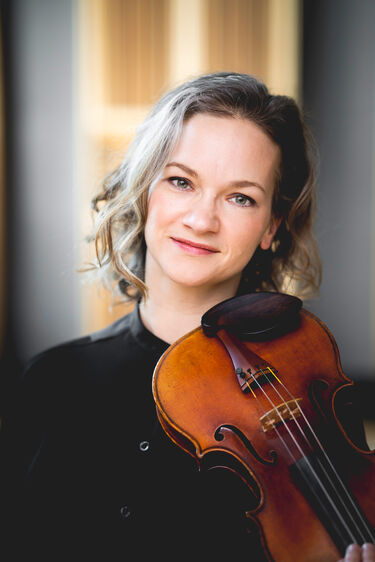
“It’s an experiment,” says Hilary Hahn about the 10. Philharmonisches Konzert. That’s not because of Max Bruch’s famous Violin Concerto No. 1 in G minor, Op. 26, which the star violinist will perform. Rather, it’s because of the rewriting of the first movement, for which General Music Director Omer Meir Wellber and she were able to enlist the help of contemporary composer Barbara Assiginaak, a member of the Anishinaabekwe tribe in North America. A conversation about an extraordinary collaboration, about interpretation, improvisation, and the question of why musical perfection cannot exist.
© ×
Do you remember how old you were when you played Bruch’s famous violin concerto for the first time?
It was a long time ago. I think I was probably eleven or twelve. It was one of my early big concerti. The American violinist Maud Powell was very famous in her time. Growing up, I had a book of her in my bookshelf, her biography, and she was kind of an icon to me. When I learned the concerto, I didn’t realize that she was connected to it, but later, I discovered that she was a champion for this piece and she toured it a lot in the course of her career.
Bruch’s violin concerto is one that can stay with you for a lifetime. Is it true that you can grow through it and mature alongside it?
I don’t remember specifically for the Bruch, but I remember that it was exciting to play pieces I was familiar with from hearing them in concerts. This is a big arrival point after learning many student-oriented works. You know how it feels in the audience, and you know what the orchestra sounds like. And then you realize that it feels different to play it than to listen to it.
When you learn something very young, you get it in your system and you won’t lose it. That makes it easier to return to — but the process of returning involves rethinking and reprogramming. You have to be conscious about that.
And yes, from time to time I decide to return to this Bruch. It has the most gorgeous second movement. It’s also in an unusual key. Very few of these major violin concerti are written in G minor, which slightly changes the way the violin rings. In G minor, the whole violin is engaged, especially if it’s G minor with raised sixth and seventh so that you have the open E. So I think it’s a pretty unique piece; the way it sings on the violin is very natural. While many violinists play it at a young age, it requires quite a bit of technique and experience to play it confidently and fluently.
„What she writes is beautiful, loaded with emotion, and expertly written.“
What is it that fascinates you the most about Barbara Assiginaak and her compositional work?
What she writes is beautiful, loaded with emotion, and expertly written. As an Anishinaabekwe tribal member in North America, which is referred to as a whole as “Turtle Island” amongst First Nations peoples, she is a tribal knowledge keeper: she keeps the knowledge of the language and medicine, she is a bush guide, she spends a lot of time on her tribal lands in the course of the year. She gets a lot of her ideas for composing when she is out in the bush, but she lives in the city, so she is also in the urban environment. When she studied in the Munich Hochschule für Musik und Theater composition department, she was the only woman there at that time and the only native person. So it’s really interesting that she had to reconcile ideas from her different environments from quite early.
How did your collaboration with Barbara Assiginaak come about?
We have a mutual friend, who spoke about her to me, and I started listening to her music. We have never met in person, but we have spoken on the phone and she has written me a solo encore called “Sphynx Moth” which I like a lot. I very much like working with Barbara, because she thinks things through, she is a very thoughtful and kind person and a highly skilled composer. She does not shy away from meaning and depth. She has a really good sense of tonality and instrumentation. She is writing conceptually, yet the notation is really great and precise. All of this makes a unique language.
When Omer Meir Wellber asked me about who I want to bring in, I was thinking: I have never worked with Barbara on an orchestral work, but I love her orchestration. At that time, I had been working on “Sphynx Moth” and enjoying how she writes for the violin and how it feels to play her music. And also I was thinking about the German connection: she’s from Turtle Island, lived in Germany and is fluent in German, and I also have found the combination of those two places formative in my musicianship, although our experiences come from different contexts.
„It’s an experiment, it’s a really interesting project, I am very excited.“
Why did you choose Bruch’s violin concerto?
I’ve never done a piece written on a piece. But I think that the Bruch is a good one because it’s so familiar to concertgoers. As performers, it is our job to consider how much to lean into that familiarity and how much to depart from it. So it is good to work with a concerto that is kind of a straightforward piece: with a clear structure, a clear presumed identity, a clear harmonic world — so that the composer interpreting has lots of space to decide how much they want to do within that. The framing is just waiting to happen. It’s an experiment, it’s a really interesting project, I am very excited.
Adding a new layer of experience to these pieces is a very interesting concept, for the audience and for the performers. I don’t think anything needs to be redone. These two concepts — the original version and the reinterpreted version — can exist peacefully on the same level. And the next time we hear the piece after hearing the reworked edition, we will think back on it. It’s a great idea to add that level of understanding and imagination to enhance the piece, also in its original form.
How would you describe the collaboration for the 10. Philharmonisches Konzert: as a symbiosis with Bruch or as a positive disruption?
It’s recognizably based on the Bruch. Barbara is definitely quoting and referencing that particular movement. It appears when you don’t expect it, and it diverges. And there is a lot of room for freedom in this particular piece. I’m curious to hear everything together, it’s going to be interesting. She is writing with the language Anishinaabemowin embedded in the score and adds a German translation. And the things that she writes in her language are, for example: “Der Nachtzug”, “Wie eine gepfiffene Melodie”, “Wie ein Nachtfalter”, “Weit entfernt oben am Nachthimmel befindet sich ein winziger Stern”, “Dann beginnt die Frau zu weinen, weil ihr Sohn vermisst wird” … And I can hear that there are elements of her writing that represent the vocal style of her language and singing. The story develops and the final indication that Barbara writes is: “Seine Großmütter in der Geisterwelt singen heute Abend”. There is a whole story, and you sense it.
Barbara is, in fact, writing in metaphor and allegory about a very personal tragedy that befell her family in recent years, that continues to carry deep wounds for her and her family, and her people as a whole. And she writes this story into her music in coded phrases that bring you in to the emotions of both the tragedy and the ongoing ripple effect of deep grief. At the same time, the piece shimmers with beauty.
„The score is just the starting point; it’s the outline, the basics. From there, actually, everything is relative.“
How important is it for classical music to break new ground? And how important, on the other hand, is it to preserve tradition?
When I was growing up in classical music, even the term “crossover” was taboo. But I never thought that was fair: sometimes the only collaboration that can happen is a collaboration that merges the genres, because you are not fully in each others’ genres to start with. Then you have to find common ground.
I’ve always been interested in collaborations across genres, because in general, I’m inspired by the creative process. I go to museums to see how the painters work, go to performances of all different kinds of artistic genres, wondering: How did they get there? What were they thinking? How can I draw a metaphor between what I’m seeing or experiencing and what I do, my creative process of interpreting.
But you still do have to follow the score?
I don’t think people realize that as concert music performers we are largely improvisatory in our interpretation. It’s like an actor with a script: you don’t try to do it the same way every evening. I don’t know if you even could. So, with written music, the score is just the starting point; it’s the outline, the basics. From there, actually, everything is relative. Even pitch in its own way is relative, tuning is relative, dynamics are relative, speed is relative, meaning is relative.
„I wanted to find out: Where can we meet in music?“
Even the instrumentation?
Yes, I mean, the violin has changed the type of sound it makes over time as people have developed it. But also markings like piano and forte and everything in between. It’s all relative to what you think piano and forte are. Or a tempo: Do I play the tempo that the composer probably thought that they were writing? Or the tempo that they actually wrote? [Laughs.]
The scores were written in a different place, in a different time, different context. When I think of Mozart: He would have never sat in a car or plane, he would have never thought of motion the way we think of motion, the shoes he wore would have been different from the shoes we wear, and the experience of riding horses all of the time and hearing the hooves out on the street and wagons rolling by ... His sense of rhythm was probably physically also very different from our sense of rhythm. We can’t pretend to know things like this. But the score is the thing that survived. So we have to take it on ourselves to figure out what it means to us.
There were other musical fusions in the past, for example with the experimental Düsseldorf artist Hauschka.
When I work with people who improvise notes, it helps me improvise interpretation. That was the case with Josh Ritter, with Hauschka, with Tom Brosseau. We need to build a joint language, an artistic identity. That really inspires me artistically. With Hauschka, the gesture of performance was from the same place, and our ideas of creativity came from the same place. So I wanted to find out: Where can we meet in music? I’m not trying to become a different kind of artist, but I want to become an artist true to myself as an interpretive and improvisatory artist, whether literally or metaphorically.
„You never know a piece until it is performed in front of the audience!“
Which moment is more significant? The moment when, while practicing and rehearsing, you achieve something for the first time with what you perceive as perfection? Or the moment when you present it to your audience in that state of perfection?
You never know a piece until it is performed in front of the audience! That’s why it is so nerve-wracking. [Laughs.] Not scary, just like: I’m walking into something I know I don’t know. [Laughs.] I know what I’m supposed to play, but I do not know what this piece wants to be in front of the audience. It first has to reveal itself in real time. So I’ve learned to let the piece speak the first time.
The premiere is very exciting. It’s a significant moment. But it’s not by any means the definitive performance. It’s when the piece arrives, like the opening night of a show or play. It’s the arriving, but it keeps changing from there, it develops from there. So it’s worth multiple hearings.
Do you recognize the audience while playing?
It is important to always be listening to the music itself and listening to what it wants to do. You can’t know what’s going to move the audience. But you can definitely know what is genuine for yourself as an artist and you can definitely hold yourself open for all these different experiences and for the audience to join you in this enjoyment of creating. And I think that’s the most powerful way to connect the stage and the seats.
The music tells you what it wants to do?
It’s not my place to change a piece, ever. It’s my place to find within it the space that I feel is authentic, in which I can play it, interpret it, be in it, and be comfortable with myself as an artist. We need to let the music be itself. In contemporary music, I have to trust the piece, be curious about it, and deliver the best version that I can. If you let it speak, it might be saying something you’ve never heard before! That’s how I approach new music. My job is to climb into it with curiosity and make it as high-quality an experience on all levels as possible.
„Music is constant motion through sound.“
What does musical perfection feel like? Does a perfect moment, a perfect interpretation exist?
I don’t know if we can aim for perfection. Because I don’t know if we can control it well enough to even achieve perfection: musical performance is constantly evolving, every moment to the next. Your arm position is always moving, and even something as fundamental as the way you apply the bow is different day to day, without your even realizing it. It’s not like painting or writing where you can leave it and come back in the next day to continue working on it. Even in practice, you can’t recreate exactly what you just did. You also can’t ever examine what’s going on. Because the second you stop, it stops. Music is constant motion through sound.
I think it’s more about fluency: you can be in a flow state. But it’s not about a “perfect” moment. I’d change the idea of perfection to a goal more like “exquisitely calibrated”, or “exquisitely applicable”. It’s this feeling that everything is where it should be. That, I think, is what makes those moments really special.
What violin do you play, and how did you two find each other? Who is playing: you or your instrument? Do you respond to your violin, or does it respond to you?
It’s a collaboration. [Laughs.] I’m currently playing a few different violins. I used to play only one, and at the moment I’m kind of experimenting with which violin feels most comfortable in any given week. I think it’s a really interesting and good process for me as a violinist to go through, because I start to see what comes down to me and what’s the instrument. And with every instrument, I’ve received different experiences. There are all these tiny differences.
Is there a favorite note to play on your instrument?
For some people there is. For me, it’s more the feeling of a creative freeness, when everything is clicking together and everyone is communicating and everything is alive in the music. It’s more a favorite experience, I think.
Interview: Teresa Grenzmann on June 22nd, 2026